Fall Wedding Arch Ideas You Can Build in an Afternoon
This post contains affiliate links, which means I may earn a small commission if you buy something through them, at no extra cost to you.
Florists quote around $1,150 to flower a fall wedding arch that a couple stands under for eleven minutes. This article is about the thing underneath that quote: the frame, what it costs, what holds it down, and how much greenery it swallows. Which flowers go on it is a separate decision, covered in what’s actually in season from September through November. Lighting it belongs to the reception lighting guide.
If there’s one piece of ceremony decor I’d build rather than rent, it’s this one. The materials cost less than a bridesmaid’s bouquet, and it is the only thing on the ceremony list you still own on Monday.
Quick Answer
A fall wedding arch costs $35 to $110 in frame materials and goes up in one afternoon. A poly-pipe circle is the cheapest DIY wedding arch, and a two-post frame is the sturdiest. Anchor every leg with at least 40 pounds before a single stem goes on, cover about a third of the frame, and plan to move it behind the sweetheart table after the ceremony.
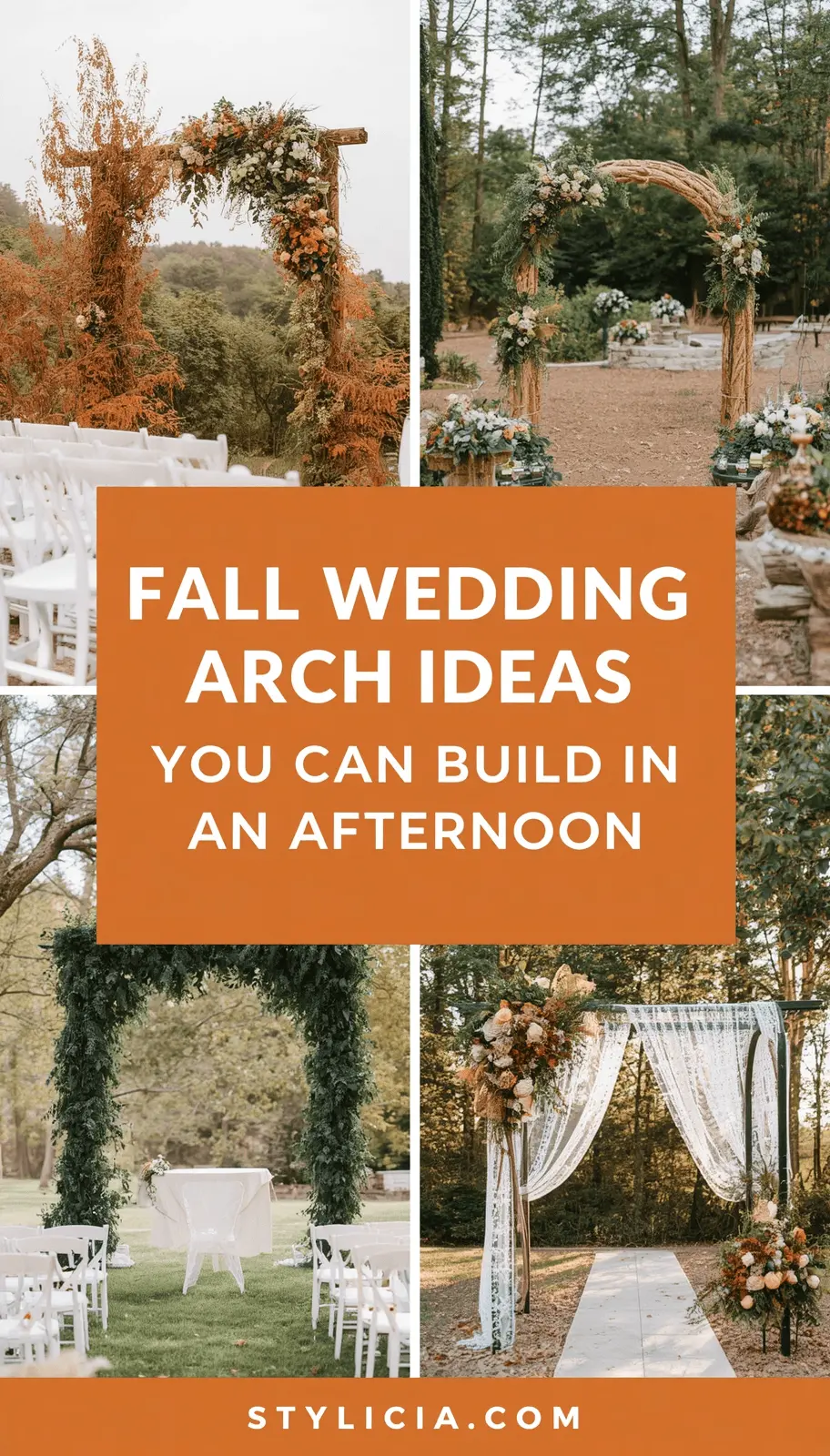
Five Frame Shapes Cover Almost Every Fall Wedding Arch
Every wedding ceremony backdrop on your saved pins is one of five shapes wearing different plants.
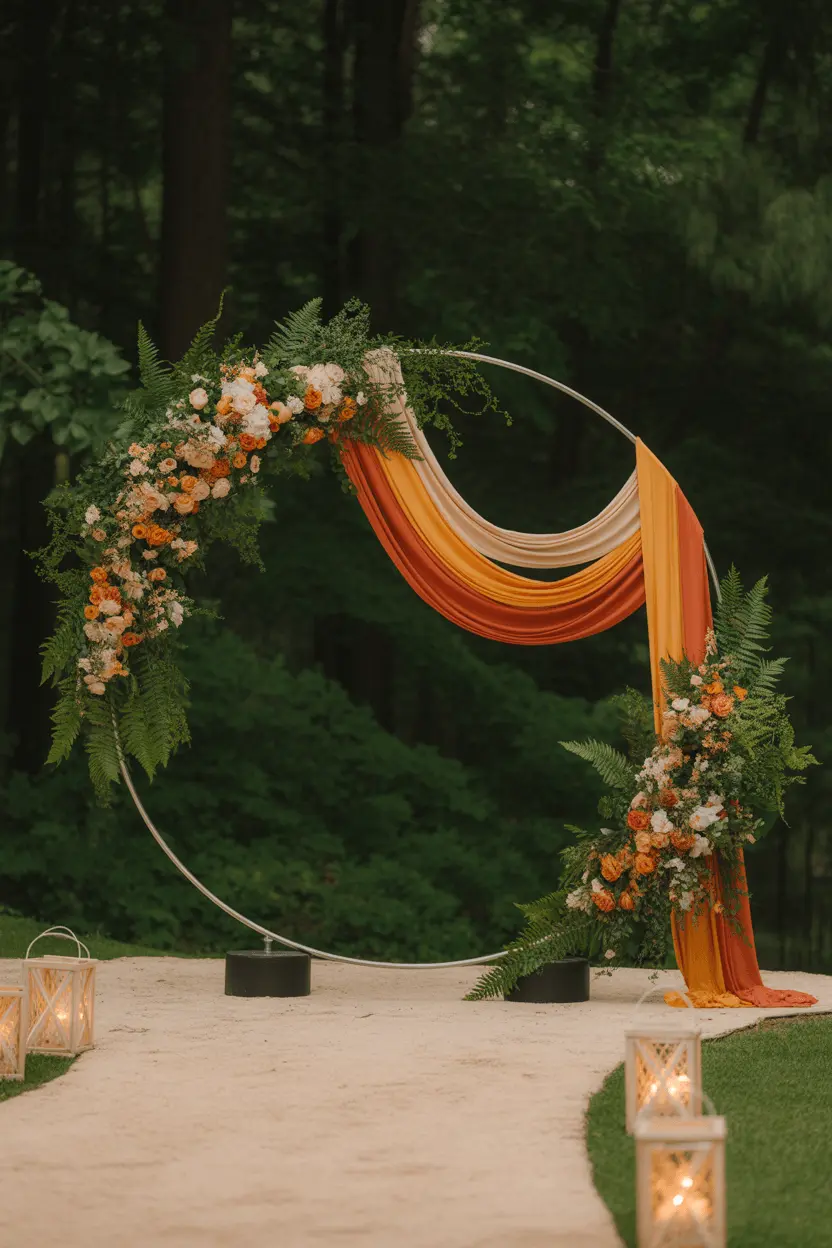
The circle. Six or seven feet across, on rebar stakes or an adjustable stand. The ring holds the couple’s heads inside a shape instead of under a beam.
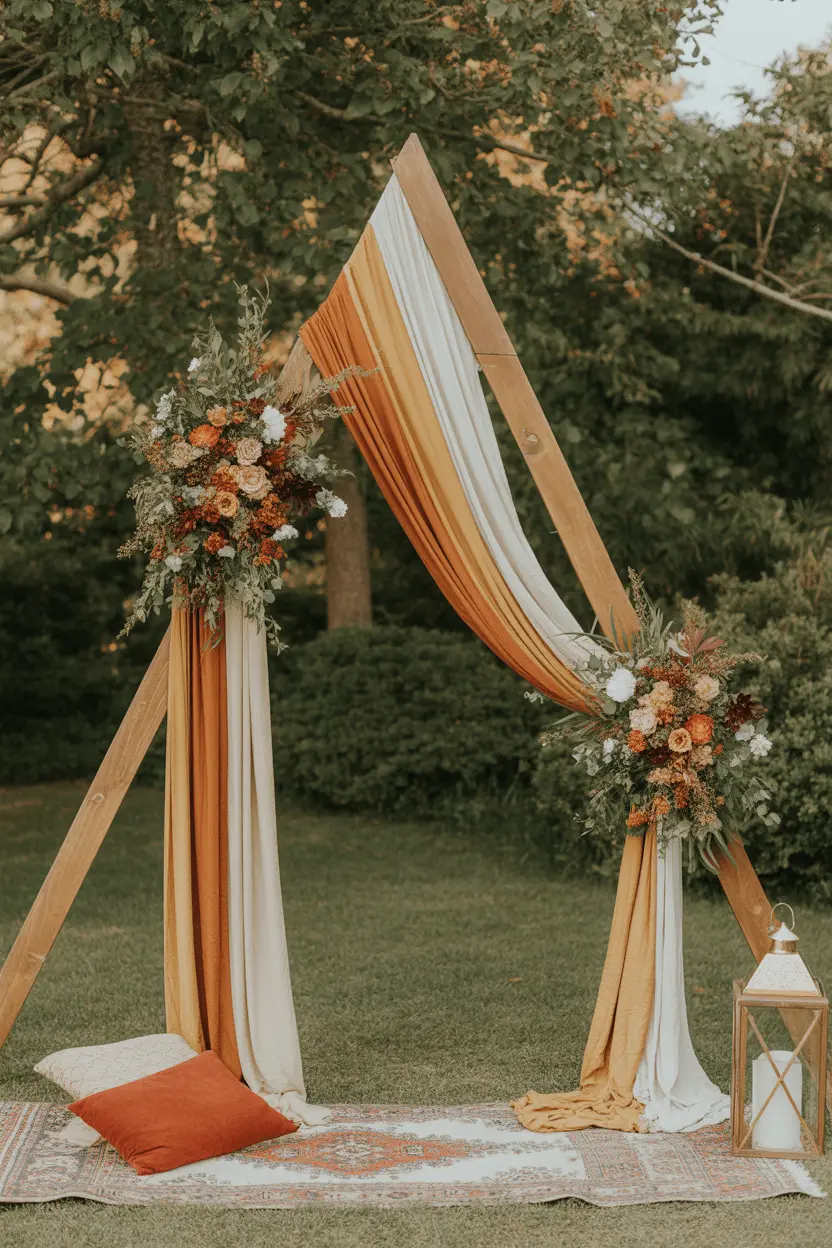
The triangle. Three lengths of 2×3 lumber, tall enough to clear a person by a head. The sloped sides carry a heavy cluster without sagging.
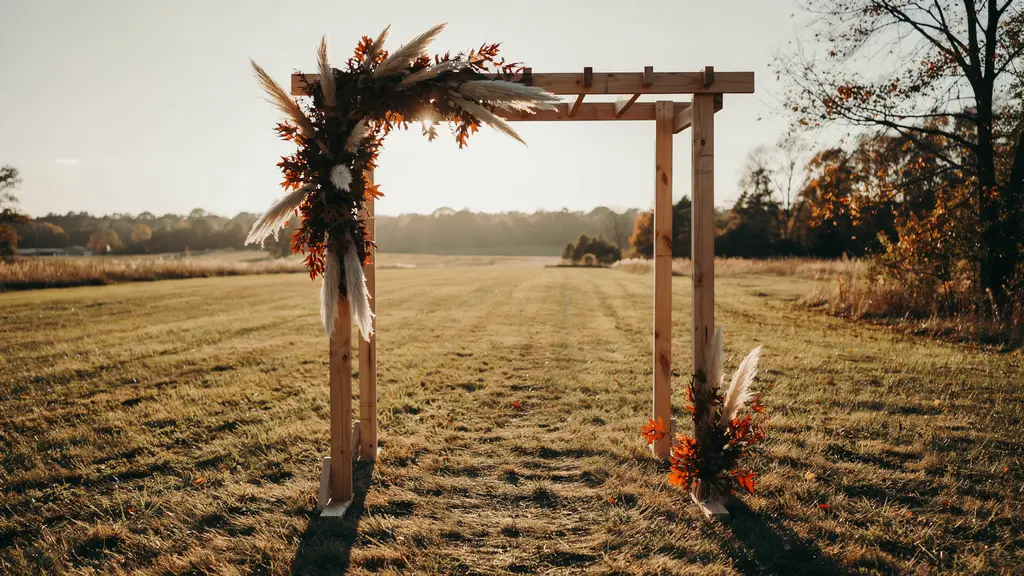
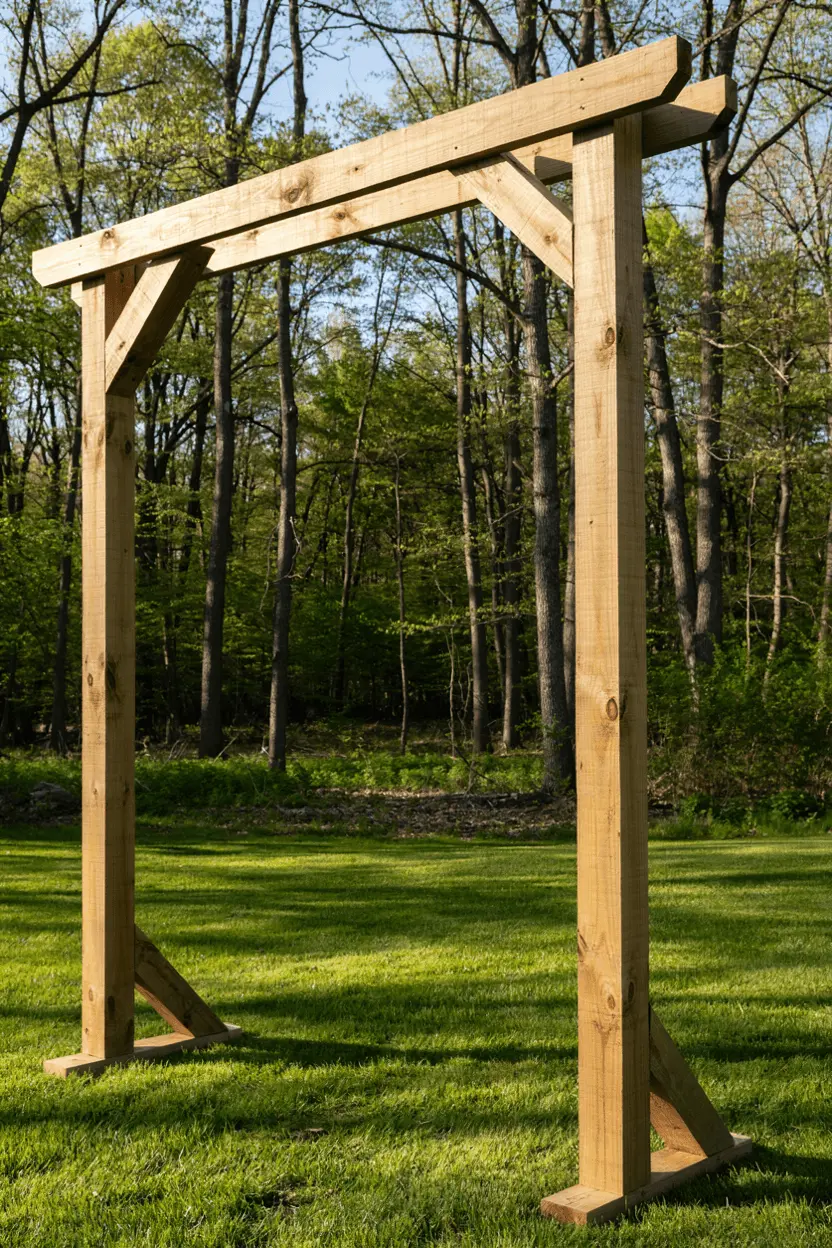
The two-post with a beam. The traditional autumn wedding altar, and the only shape that takes a full flower install without flexing.
A living tree. Free, and a mature oak beats anything you can build. It still needs a cluster at the base, or it looks like you happened to stand in a field.
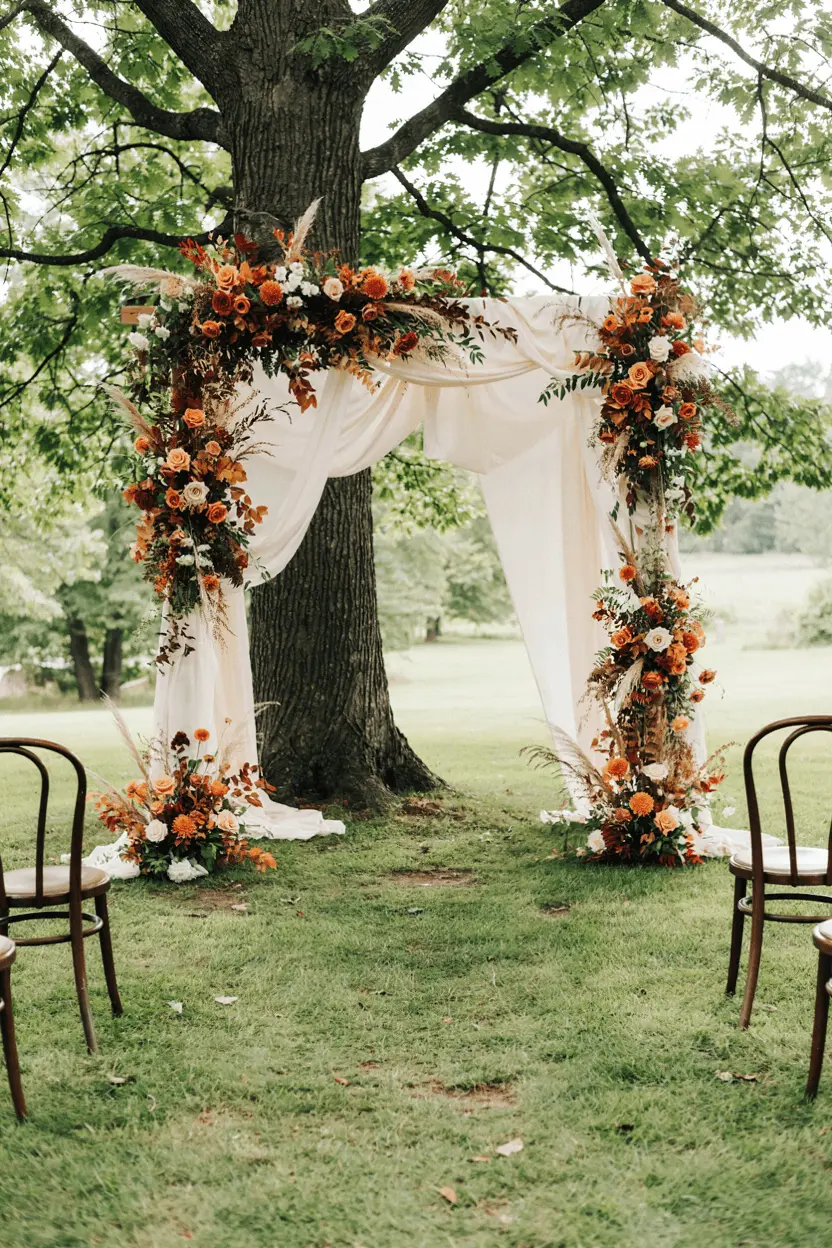
A bare branch installation. Branches lashed into a fan and staked. This one goes wrong most often, because branches need a wide stance to stay up.
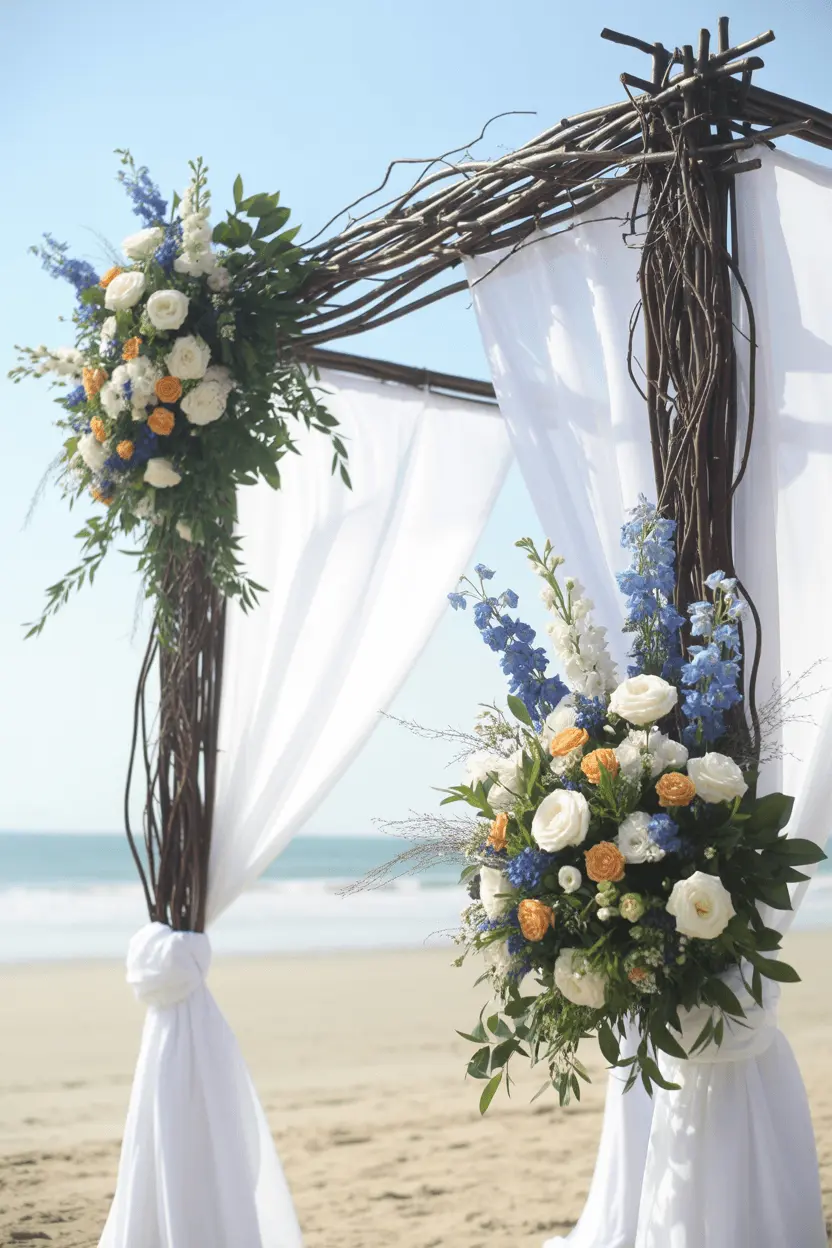
Whichever shape you pick, picture your fall wedding arch at the end of the afternoon with the sun behind it. The foliage goes from color to silhouette, the uncovered part of the frame turns into a clean line, and the couple stands inside a lit shape rather than in front of a decorated object. That is the photograph everyone is after, and it is why the bare half matters as much as the loaded half.
Feel free to go bigger than the space seems to need. These always look smaller in a photograph than they did standing in the field.
| Shape | Frame cost (DIY) | Build time | Anchor per leg |
|---|---|---|---|
| Circle, 6 ft | $35–$60 | 45 min, one person | 40 lb |
| Triangle, 7 ft | $35–$55 | an hour, two people | 45 lb |
| Two-post + beam, 8 ft | $70–$110 | 90 min, two people | 50 lb |
| Living tree | free | 30 min | none |
| Bare branch fan, 9 ft | $0–$40 | 75 min, three people | 60 lb |
Covering a frame completely triples the plant material, and that is where the four-figure florist quotes come from.
Renting Beats Building Exactly Once
Rental companies quote $150 to $450 for a wooden arbor, plus delivery inside a window you don’t get to choose. Lumber for a two-post frame runs about seventy dollars.
Renting wins if you’re doing this once and your setup window is short. Building wins the moment there’s a second use, and there usually is: a backdrop for someone else’s shower, a trellis with clematis by June.
(This is the one line on the page where I’d argue against the cheaper option. A rental goes back on Sunday morning, and a frame you built is still standing in the garden in six weeks.)
A florist building and installing it starts around $600 and climbs from there. That price buys you a frame you don’t keep.
The Two-Post Frame Is the One I’d Build First
It’s the sturdiest fall wedding arch shape and the only one that takes a full install without flexing. It also looks like furniture afterward. Sanded, oiled and left standing at the end of a garden, it stops being wedding decor by November.
What you need: two 8-foot 4×4 posts, one 6-foot 2×6 beam, four heavy-duty L-brackets with screws, two 5-gallon buckets, two bags of fast-setting concrete. Cost: $65–$75. Time: 90 minutes of work, plus an overnight cure.
- Sand the post ends and the beam edges. Splinters find bridal fabric.
- Mix one bag of concrete per bucket to a thick oatmeal texture. Set a post in the center of each, plumb it, brace it with scrap.
- Check plumb again at 5 minutes and at 10. Fast-setting concrete moves while it stiffens.
- Cure overnight. Each bucket weighs about 85 pounds after that, a two-person lift.
- On site, set the posts 6 feet apart, inside face to inside face, and attach the beam with two L-brackets per side.
- Hide each bucket under a galvanized tub, or burlap and three sugar pumpkins.
(Step three is the one I wouldn’t skip. Fast-setting concrete drifts while you’re standing back admiring the first post, and a lean shows up in every photograph afterward.)
A Circle Is One Roll of Pipe and an Afternoon
Black poly irrigation pipe bends into a clean ring, holds its shape in the cold, and disappears under greenery. A roll yields five rings, so the second one is free.
If cutting and clamping pipe is not how you want to spend a Saturday, there’s a shortcut. A round metal backdrop stand runs $45 to $90, breaks down into a bag, and takes zip-tied greenery the same way.
What you need: a 100-foot roll of 1-inch black poly irrigation pipe, a short length of wood dowel that fits snugly inside it, four hose clamps, two 4-foot lengths of rebar. Cost: $35–$60 for the first ring. Time: 45 minutes, one person.
- Cut just under 20 feet of pipe. The ring takes a little over three times the width you want, plus a hand’s width of overlap.
- Sit both ends in hot tap water for 2 minutes, until the pipe softens enough to flex.
- Slide the dowel halfway into one end, bend the pipe into a ring, push the other end onto the exposed half.
- Two hose clamps per side over the dowel. Put the joint at the bottom, where a greenery cluster hides it.
- Drive the rebar 18 inches down, 3 feet apart, and zip-tie the ring to each stake at three points. On a terrace, use an adjustable stand instead.
(A kitchen floor in February is a perfectly good place to build this one, which is more than I’d say for the two-post frame.)
💰 Budget Pick
A roll of 1-inch black poly irrigation pipe costs $40 to $50 and yields five 6-foot rings, which works out to about nine dollars of frame per arch. Best dollar-per-frame ratio on this page.
Anchor the Base Before You Hang a Single Stem
Wind load climbs with the square of the speed, so a breeze that felt fine at 10 mph pushes four times harder at 20. Arches don’t blow over dramatically either. They lean, then go sideways, slowly, in front of everyone.
The weights I’d use: 40 pounds per leg on a calm day, 75 per leg when gusts over 15 mph are forecast, and above that, strip the greenery off rather than pile on more sand. A bare frame catches almost nothing.
Sandbags are where I’d spend rather than improvise, because cinder blocks hold the same weight and look like cinder blocks in every photo from the aisle. Photography sandbags run $18 to $28 each filled, and you want two per leg, flat under a linen.
Stakes do the same job when the ground cooperates. Driven at an angle, two per leg, with a guy line to the upper third of the frame, they hold a surprising amount in firm turf. Autumn ground is the problem. A lawn that took a stake fine in August has had a month of rain by mid-October, and after two wet days a stake holds almost nothing. Test one by pulling it out with your hand the morning of, not the week before.
Where nothing can be driven in, used gym plates stack under fabric for about a dollar a pound.
Greenery Gets Measured in Linear Feet, Not Bunches
Measure the feet of frame you intend to cover, then buy by the foot rather than by the bunch. Full coverage takes five or six eucalyptus-sized stems per linear foot, and airy coverage half that. A third of a 6-foot circle lands around 35 stems, which is two supermarket armfuls rather than a florist order.
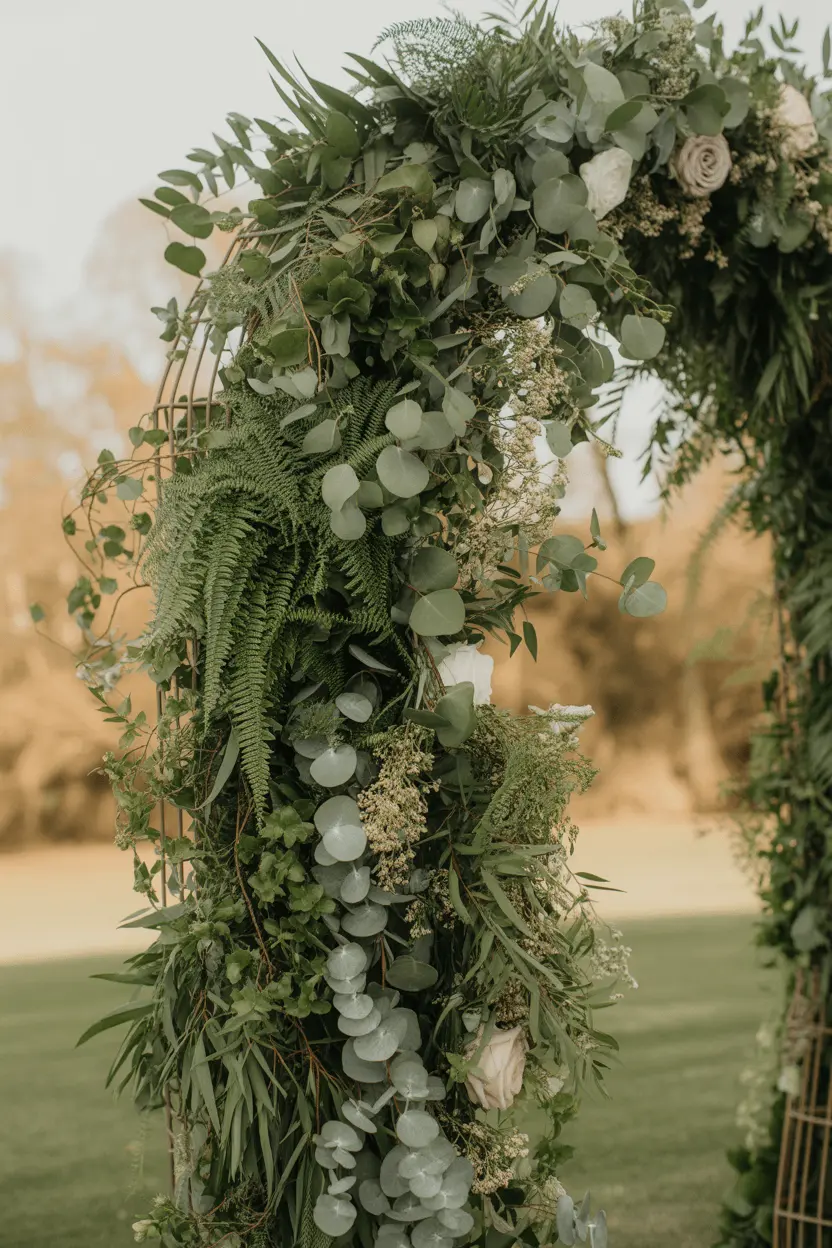
Faux garlands hide a trap. A 6-foot garland covers about 4 feet once the ends overlap, so an 8-foot run wants three, not two.
Preserved and dried material is what makes any of this survivable. Preserved oak leaves and dried pampas run $20 to $45 a bundle, go on a week early, and don’t care about heat or wind. One bundle covers the cluster at the base, two build the main corner.
Cold is on your side up to a point. Fresh greenery left on the frame overnight in October holds far better than it would in June, which is why a warm garage does more damage in the fall than the weather does. A hard frost is where it turns. Anything fresh goes limp and blackens at the edges by morning, so check the overnight low before you leave material out.
Build the greenery off the frame rather than on it. A roll of vinyl-coated chicken wire costs $18 to $30 and makes the panel you weave stems into on a garage floor, sitting down. Use black zip ties rather than white, because white shows against dark foliage from the third row back.
Pro Tip
Build the greenery on a panel of chicken wire off the frame, the day before. Cut a piece about 24 by 36 inches, weave the stems through, then zip-tie the panel to the arch on site. That cuts on-site work from two hours to twenty minutes.
Asymmetric Coverage Costs Forty Percent Less and Looks Deliberate
On a fall wedding arch, one heavy corner with a small answering cluster beats an evenly wrapped frame at every price point.
The proportion that works: a main cluster running down one leg and across part of the top, then a second at the opposite base about a third the size. That 3:1 ratio leaves most of the frame bare, and bare frame is free.

Bare is also the part that photographs. Late in the day the light comes through the open side of the ring while the loaded corner goes dark against it, so you get depth instead of a wall of leaves. Wrap the whole thing and there is no light left in the shape.
Full coverage only earns its cost when the frame itself is ugly. A rental arbor in orange-toned pine needs hiding. A sanded 4×4 or a black pipe ring does not.
There’s no correct ratio on a fall wedding arch, and the thing that shifts it is distance. Guests thirty feet back see shape, so one bigger mass wins. Close up they see individual stems, so two smaller clusters hold up better. Bronze foliage also carries more visual weight than green, so the same armful of preserved oak fills more of the eye in October than ruscus would in May.
Your Fall Wedding Arch Should Work Twice, and the Second Place Is Behind the Sweetheart Table
A ceremony backdrop is on camera for about twenty minutes. Behind the sweetheart table it works all night.
Plan the move at the rehearsal: two named people, one window during cocktail hour. Carried whole, a two-post frame with concrete buckets takes four people and a flat path. Built in halves, with the beam lifted off first, two people and about fifteen minutes.
Set it a couple of feet behind the chairs, or it crowds the couple’s heads in every photo from the dance floor. Indoors, stakes are out, so swap in weight plates or sandbags under a floor-length linen. Plenty of venues won’t allow anything freestanding over seven feet near a dance floor, so ask before you build taller.
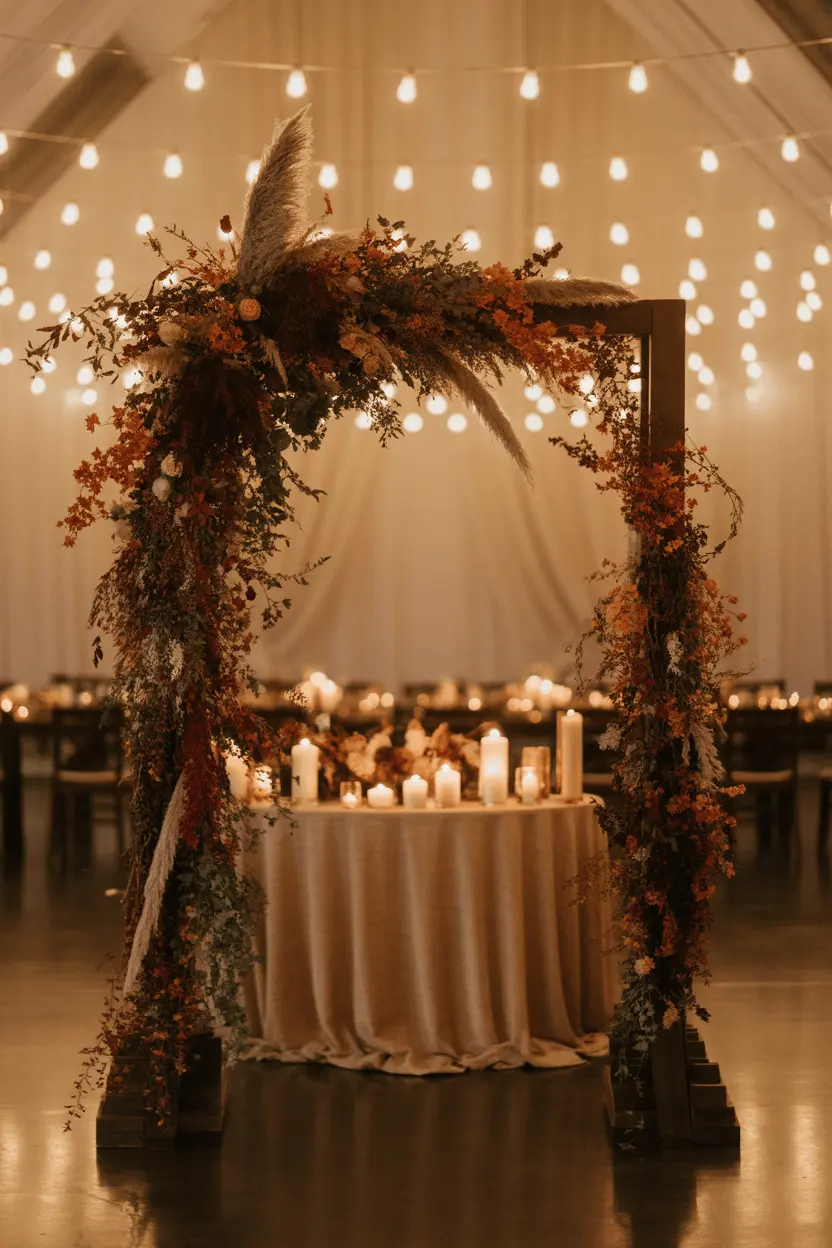
What you get for the trouble is the second picture of the night: the same foliage, lit by candles from below instead of by the sun from behind, with two people eating underneath it. More on what else belongs back there in reception details that carry a room after dark.
(And yes, this is the opposite of what most arch guides say, which is to build it once, stand it in the field and leave it there.)
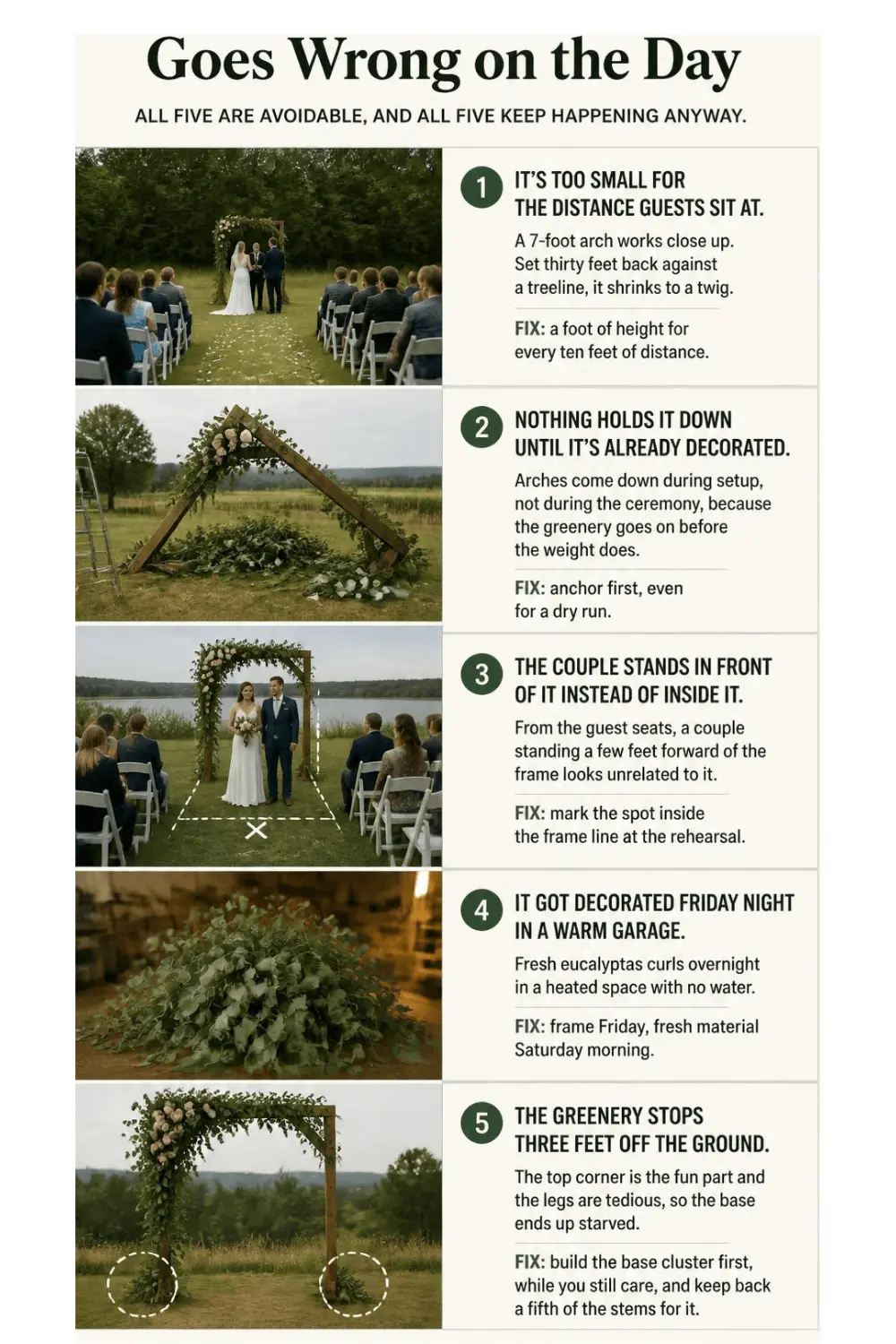
Five Ways an Arch Goes Wrong on the Day
All five are avoidable, and all five keep happening anyway.
It’s too small for the distance guests sit at. A 7-foot arch works close up. Set thirty feet back against a treeline, it shrinks to a twig. Fix: a foot of height for every ten feet of distance.
Nothing holds it down until it’s already decorated. Arches come down during setup, not during the ceremony, because the greenery goes on before the weight does. Fix: anchor first, even for a dry run.
The couple stands in front of it instead of inside it. From the guest seats, a couple standing a few feet forward of the frame looks unrelated to it. Fix: mark the spot inside the frame line at the rehearsal.
It got decorated Friday night in a warm garage. Fresh eucalyptus curls overnight in a heated space with no water. Fix: frame Friday, fresh material Saturday morning.
The greenery stops three feet off the ground. The top corner is the fun part and the legs are tedious, so the base ends up starved. Fix: build the base cluster first, while you still care, and keep back a fifth of the stems for it.
Once the Frame Is Solid
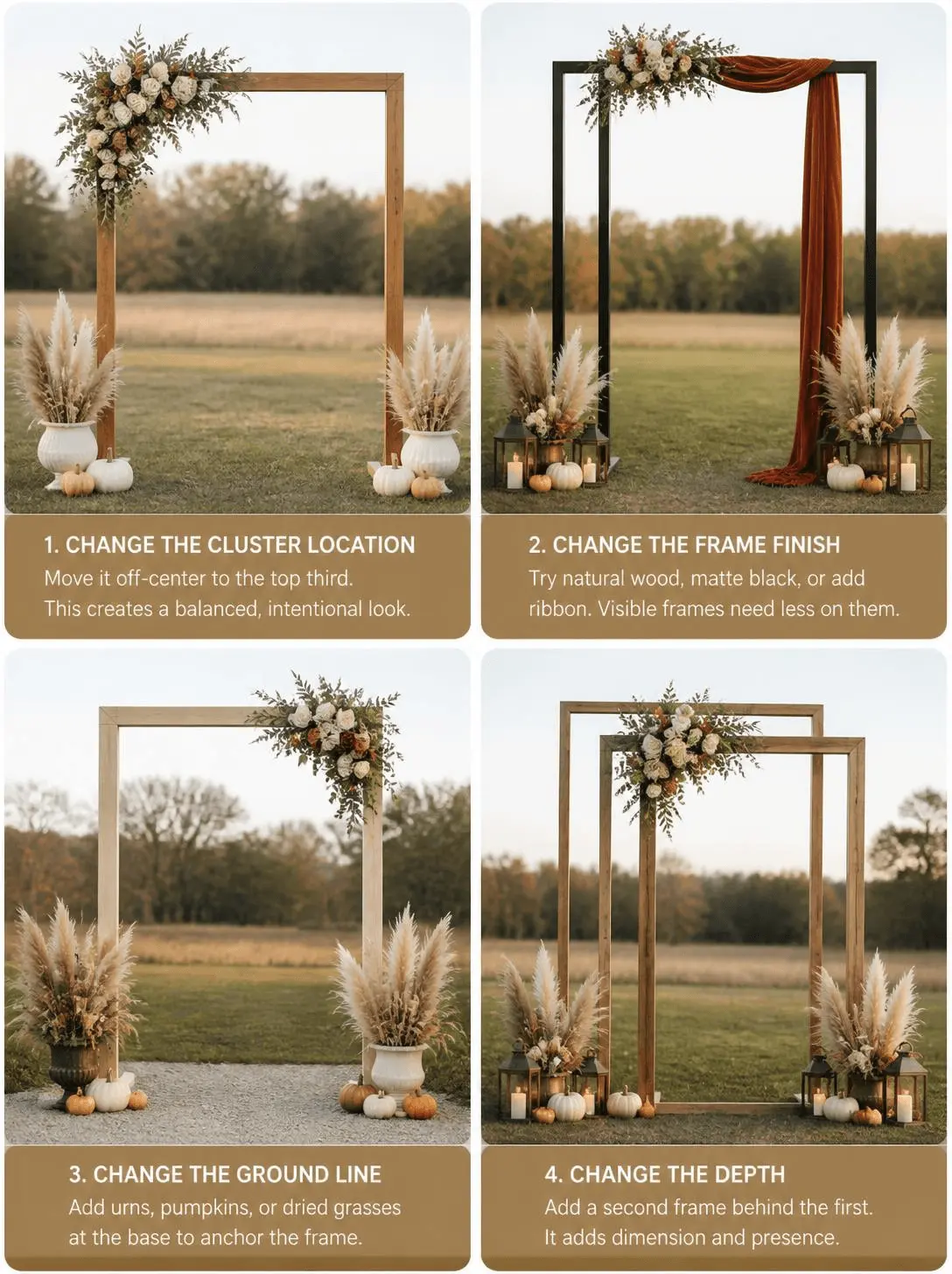
Change one thing per version and you’ll learn more than another hour of scrolling wedding arbor decor teaches.
Change where the cluster sits. Move it from the top corner to an off-center third of the top run. The frame stops looking like a doorway.
Change the frame’s finish. A frame you can see needs less on it, so sand and oil the wood instead of hiding it, or spray the pipe matte black. Wide velvet ribbon does a similar job at $8 to $15 a roll, and one roll trails down a leg and along the beam.
Change the ground line. Two urns, three sugar pumpkins, or dried grasses at each base. Cheapest fix for the fifth mistake above.
Change the depth. Set a smaller frame a hand’s width behind the first. Two circles, offset, give a flat backdrop real dimension.
Don’t be afraid to build the frame twice. The second one takes half the time and stands straight.
Frequently Asked Questions
How much does it cost to build a DIY wedding arch?
Frame materials run $35 to $110. A poly-pipe circle is cheapest, a two-post frame with concrete bases the most expensive. Greenery is the part that varies, and that depends on how much of the frame you cover.
How many stems do I need to cover a wedding arch?
Count linear feet, not bunches. Full coverage takes five or six eucalyptus-sized stems per foot, and a third of the frame, which is the version I’d do, needs around 35.
What size should a wedding arch be?
Seven feet tall and six feet wide handles most ceremonies. Lower and the couple’s heads crowd the top piece in photos. Go taller if guests sit well back.
How do I keep a wedding arch from blowing over outside?
Weight it before you decorate it: 40 pounds per leg on a calm day, 75 if gusts are forecast. The thing that actually goes over on a windy day is the unweighted sign easel standing beside it.
Can one person set up a wedding arch alone?
A circle on rebar stakes, yes, in about 45 minutes. Anything with a beam needs a second person to hold a post plumb, and the concrete bases are a two-person lift.
Is it cheaper to rent or build a wedding arch?
Renting runs $150 to $450 plus delivery and wins if you’re doing this once. I’d build, because rental money never comes back.
How long before the ceremony should I decorate the arch?
Frame the day before, fresh greenery the morning of. Eucalyptus zip-tied on in a warm garage on Friday night has curled by Saturday afternoon. Preserved material can go on a week early.
Can I move the ceremony arch to the reception?
Yes, and it’s the best-value decision here. Build it in halves, name two people at the rehearsal, move it during cocktail hour.
Shop the Look
- A round metal backdrop stand, if you’d rather not cut pipe
- Photography sandbags, two per leg, flat under a linen
- A roll of vinyl-coated chicken wire for the greenery panel
- Preserved oak leaves and dried pampas, one bundle for the base and two for the corner
- Wide velvet ribbon in rust or sage, a roll for the leg and beam
Check current listings before buying. Prices on this page were checked in August 2026, and wedding hardware moves between May and October.
Build the Frame This Weekend
On a fall wedding arch, the shape decides the cost, the anchor decides whether it’s still standing at four, and the coverage ratio decides the plant bill.
Start with the frame, not the flowers. Buy the lumber or the pipe roll on Saturday morning, build it in the driveway, then stand it up empty and look at it from where your guests will sit. Nine times out of ten it wants to be taller.
Expect the cluster ratio to take a couple of tries, and don’t count that against yourself. A frame that gets rebuilt once is a frame worth keeping. Everything it has to match sits in the full fall wedding decor plan.
Stylicia Tip
Photograph the empty frame from where your photographer will stand, at the hour of the ceremony. In late October the sun sits low enough to blow out a backlit backdrop entirely, and you’d rather find that out in the driveway.
Keep Reading on Stylicia