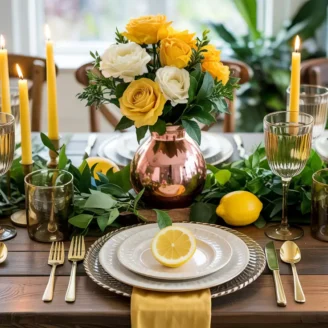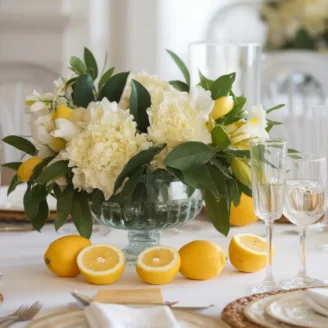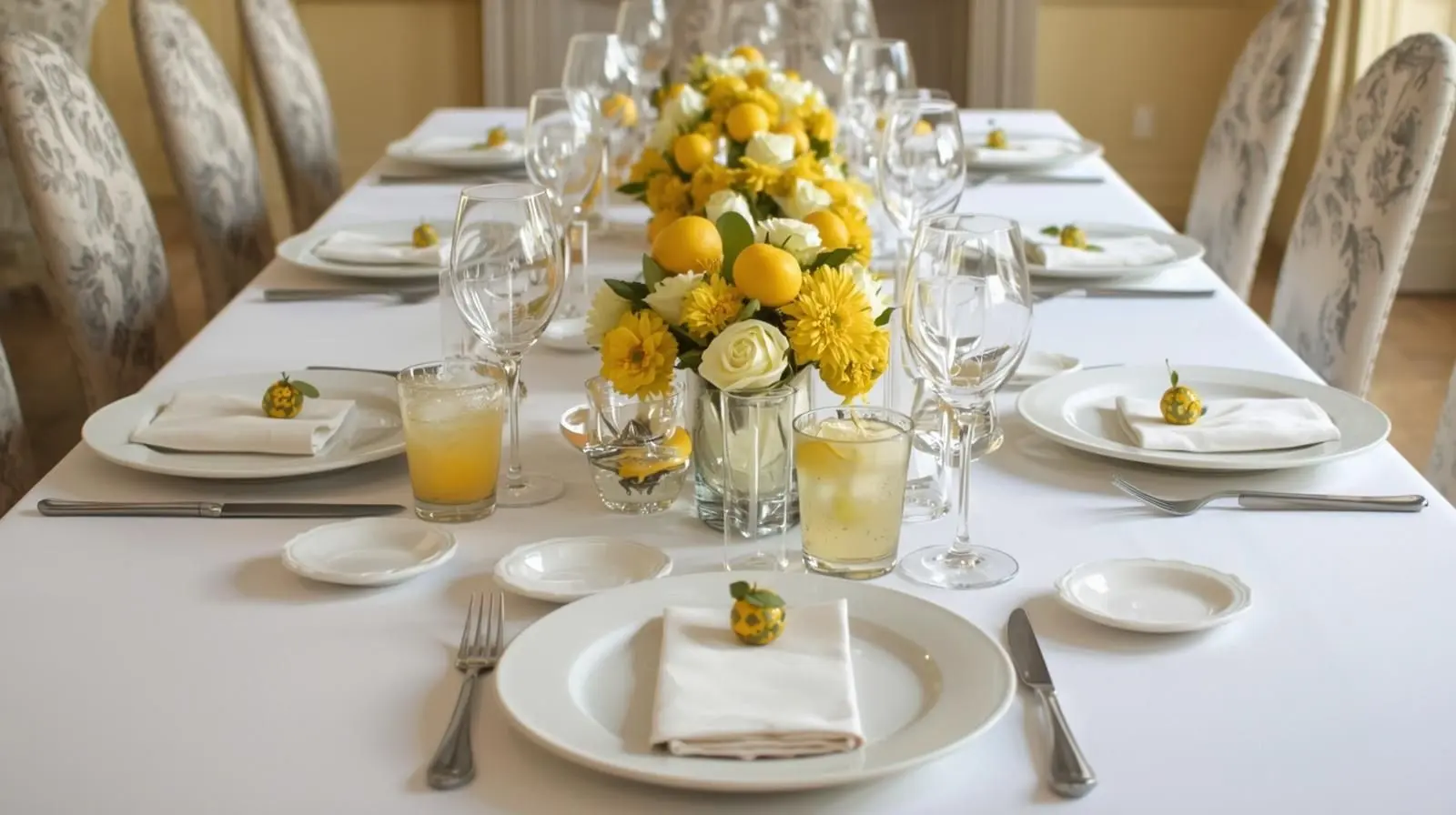
How to Set a Lemon-Themed Table in 7 Steps (Complete Guide)
Setting a lemon table setting is more about layering than buying — you can pull together a Pinterest-worthy setup with three or four key pieces and a $6 bag of grocery-store lemons.
The trick is the order: most people start with the centerpiece and work outward, but the pros build the base first and let everything else fall into place. These seven steps are the exact order I follow whether I’m setting a casual brunch for four or a dinner party for twelve.
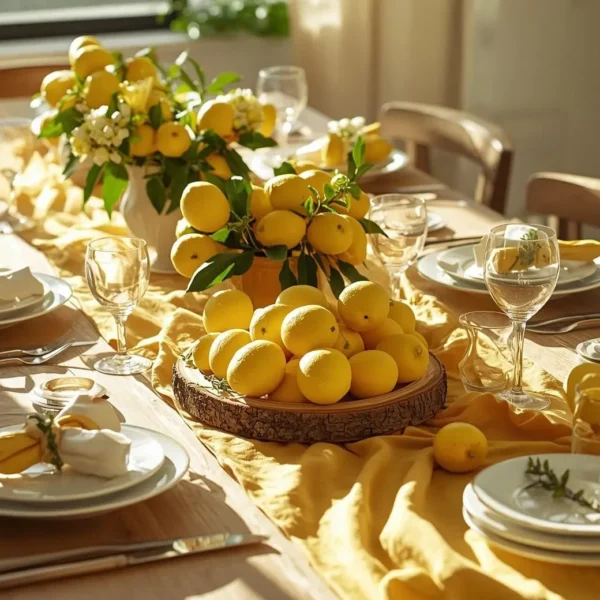
Step 1: Start with the Base Layer
The base layer determines how formal the rest of the table reads. For a casual lunch or brunch, leave the table bare if it’s wood. For dinners and events, use a white or natural linen tablecloth — never a yellow one.
Yellow tablecloths overpower the lemons and tip the entire scene into kid-birthday-party territory.
If your tablecloth is wrinkled, hang it in the bathroom while you shower the morning of — the steam relaxes the wrinkles without ironing. Linen will always look slightly rumpled; that’s part of the charm, so don’t fight it.
Step 2: Add the Runner
A runner is what separates a thrown-together table from a designed one. Lay it down the center of the table lengthwise, with about 6-12 inches hanging off each end. Three runner options work for lemon tables:
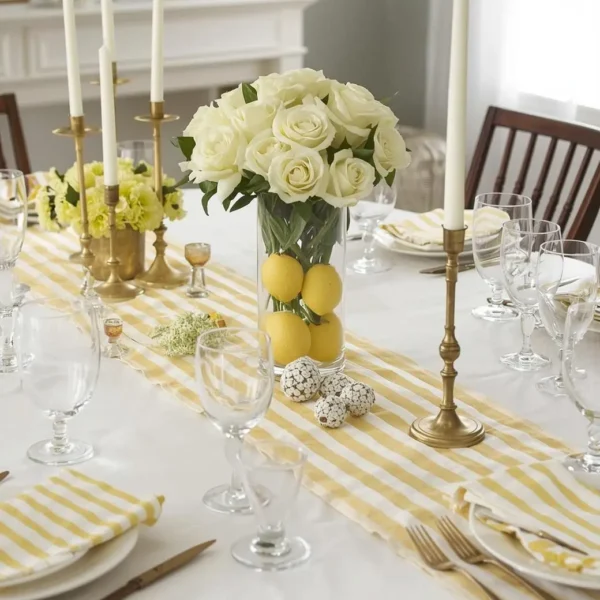
- Yellow-and-white striped — the most photogenic and most Italian. Around $15-25 on Amazon.
- Botanical lemon print — more theme-committed; works best when everything else is restrained.
- Greenery garland — skip fabric and use a long eucalyptus or olive branch garland as your runner. Frames the centerpiece naturally.
Step 3: Build the Centerpiece
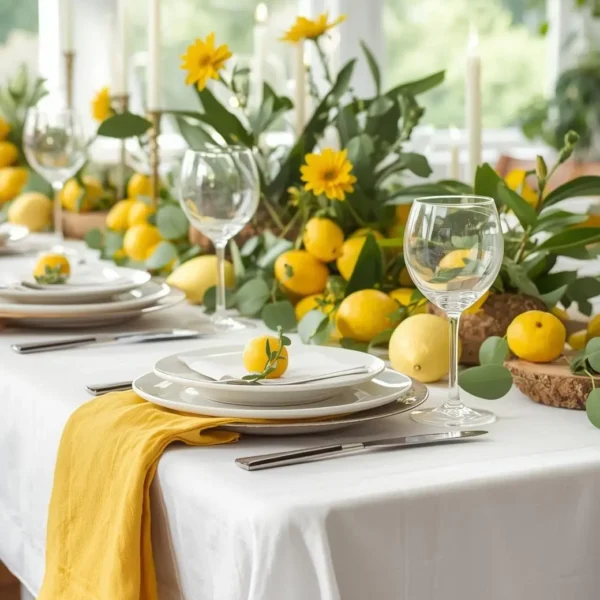
This is where most lemon table setting succeeds or fails. The single most important rule: keep it under 12 inches tall, or use narrow vertical pieces that don’t block sightlines. Guests need to see and talk to each other across the table.
The simplest centerpiece formula that works every time:
- Place a clear glass cylinder vase (10-12 inches tall) at the center of the runner.
- Fill the vase 80% full with whole lemons (about 8-10 lemons).
- Add 3-5 stems of white roses, hydrangeas, or eucalyptus on top — the lemons hold them in place.
- Tuck 2-3 sprigs of rosemary or basil between the lemons for fragrance.
Total time: 5 minutes. Total cost: about $15 if you have the vase, $30 if you don’t.
Step 4: Layer the Lemon Table Setting
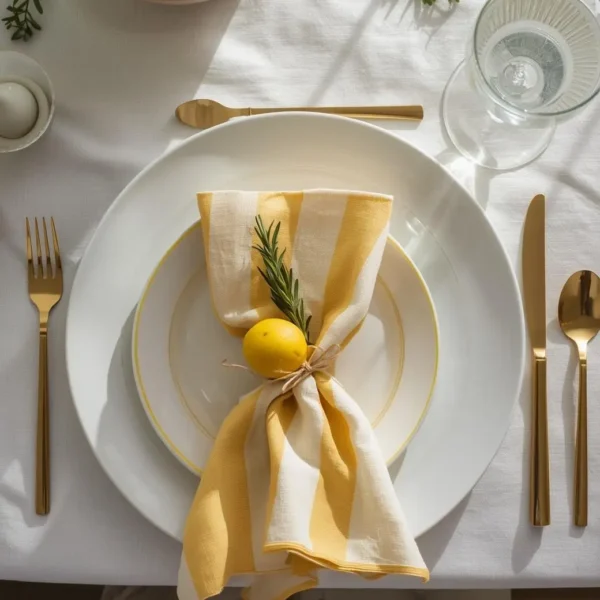
Place settings should support the centerpiece, not compete with it. The formula that always works for a lemon table setting:
- White dinner plate (10-11 inch) as the foundation
- Smaller salad or appetizer plate (8 inch) on top — white, or with a thin yellow rim
- Yellow or yellow-and-white striped napkin folded simply or rolled and tied with twine
- A small lemon, sprig of rosemary, or place card resting on top of the napkin
- Simple brass, gold, or stainless flatware to the sides
- A water glass at upper right, wine glass behind if dinner is formal
Step 5: Add the Candles
Candlelight is non-negotiable for an evening lemon table setting. Without it, even a perfectly styled table reads flat. Two lighting options based on formality:
- Taper candles — the most photogenic option. White or pale yellow tapers in clear glass, brass, or simple ceramic holders. Group in odd numbers (3 or 5) at varying heights along the runner.
- Votive candles — easier and safer for outdoor or kid-friendly events. Scatter 6-10 small votives down the length of the runner.
Avoid scented candles on dining tables — they compete with the food and the natural lemon-and-herb fragrance from the centerpiece.
Step 6: Place the Personal Touch
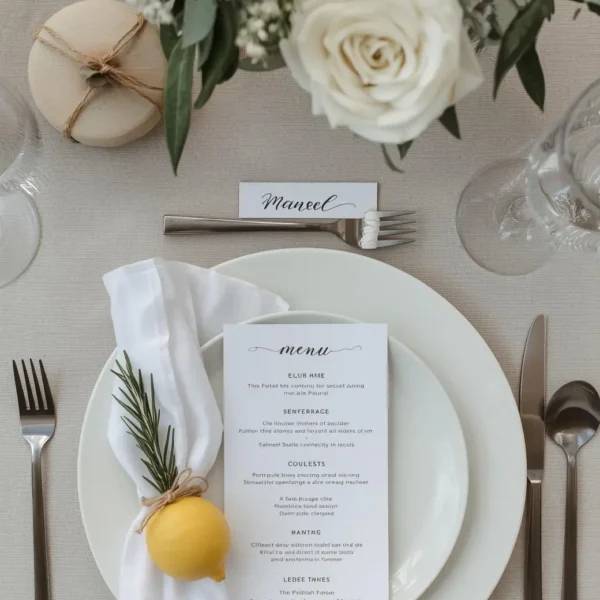
This is the step that separates a styled table from a finished one. Add one small element at each place setting that signals you thought about each guest individually:
- A single fresh lemon — with a small handwritten name tag tied around the stem with twine. Doubles as place card and party favor.
- A sprig of rosemary or olive — tied with twine to the napkin. Adds fragrance and color.
- A small place card — white card with hand-lettered name in dark ink, propped against the salad plate.
- A printed menu card — for dinner parties, list the courses or just the main dish. Reads sophisticated even at casual events.
Step 7: Final Edit and Adjustments
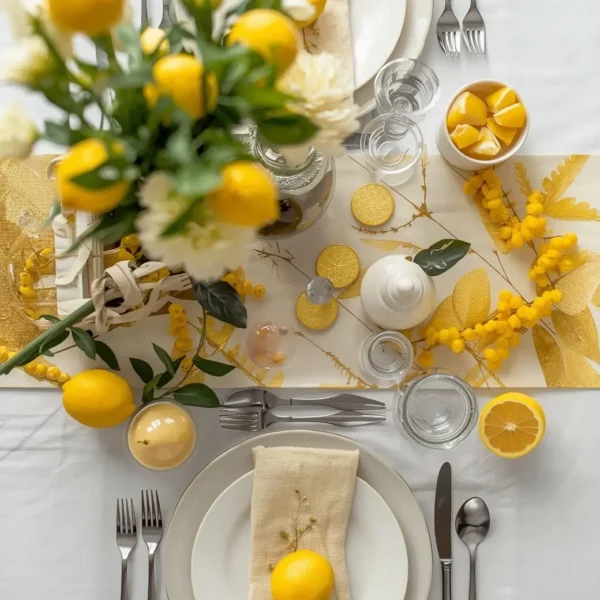
Before guests arrive, sit in each chair around the table and check the view. What looks great standing up can look cluttered or off-balance at eye level. Three things to adjust:
- Centerpiece height — can you see the person across from you? If not, lower it or split into two smaller arrangements.
- Symmetry of place settings — every plate should sit the same distance from the table edge. A consistent 1-inch gap reads polished.
- Negative space — if the table looks crowded, remove something. The most common mistake is adding too much, not too little.
The Complete Shopping List for 8 Guests
If you’re starting from scratch and want to create a beautiful lemon table setting for 8 people, here’s everything you need and what it’ll cost on Amazon. The starred items deliver the highest visual impact relative to cost.
- Linen tablecloth (60×102″) — $25-40
- Yellow-and-white striped runner — $15-25
- Glass cylinder vase (12 inch) — $15-20
- Set of 8 linen napkins (yellow or striped) — $25-40
- Brass taper candle holders (set of 4) — $25-35
- White taper candles (12 pack) — $10-15
- Real lemons (12 pack from grocery) — $6-9
- White roses or eucalyptus (3-5 stems) — $8-15
3 Mistakes to Avoid
These are the three errors that show up most often, and each one is easy to avoid once you know what to look for.
- Yellow tablecloth. Always use white, natural linen, or bare wood as your base. Let yellow come from accents only.
- Centerpiece too tall. Anything over 12 inches blocks conversation. Keep arrangements low and wide.
- Skipping greenery. Lemons alone look artificial. Always add eucalyptus, olive, basil, rosemary, or lemon leaves.
Frequently Asked Questions
How long does it take to set a lemon-themed table?
Once you have all the pieces, completing your lemon table setting for 8 takes 20-25 minutes — about 5 minutes for the base and runner, 5 for the centerpiece, 10 for the place settings, and 5 for candles and personal touches.
The first time you set one, budget closer to 45 minutes; you’ll get faster with practice.
Can I set a lemon table for a small space or apartment?
Yes — small dining tables actually work beautifully for lemon table setting ideas because the layered look reads more impactful in a compact space. Skip the long runner and use placemats instead, choose a single small centerpiece (a 6-inch pedestal bowl or a single bud vase trio), and keep place settings minimal: one plate, one napkin, one piece of greenery.
What’s the most important element to get right?
The centerpiece — guests look at the center of the table first, and a beautiful centerpiece on a basic tablecloth will always outperform a basic centerpiece on an expensive tablecloth.
If your budget is tight, invest in the vase or bowl and let everything else be simple white and grocery-store lemons.
Do I need matching dishes for a lemon-themed table?
No — and forced matching often looks more amateur than thoughtful mixing. White plates from any source work together as long as they’re roughly the same shade of white. Mix sizes, mix textures (some smooth, some textured), and don’t worry about brand. The lemon theme comes from the linens, centerpiece, and accents, not the dishes themselves.
Set Your Table This Weekend
The best way to learn lemon table styling is to actually set one — read this guide, then pull a few pieces together for Saturday brunch or Sunday dinner.
Start with the basics: a white tablecloth, a striped runner, a glass cylinder vase with lemons, white plates, and yellow napkins. That’s it. Once you’ve set one, the next one takes half the time and you’ll know exactly what you want to add or change.